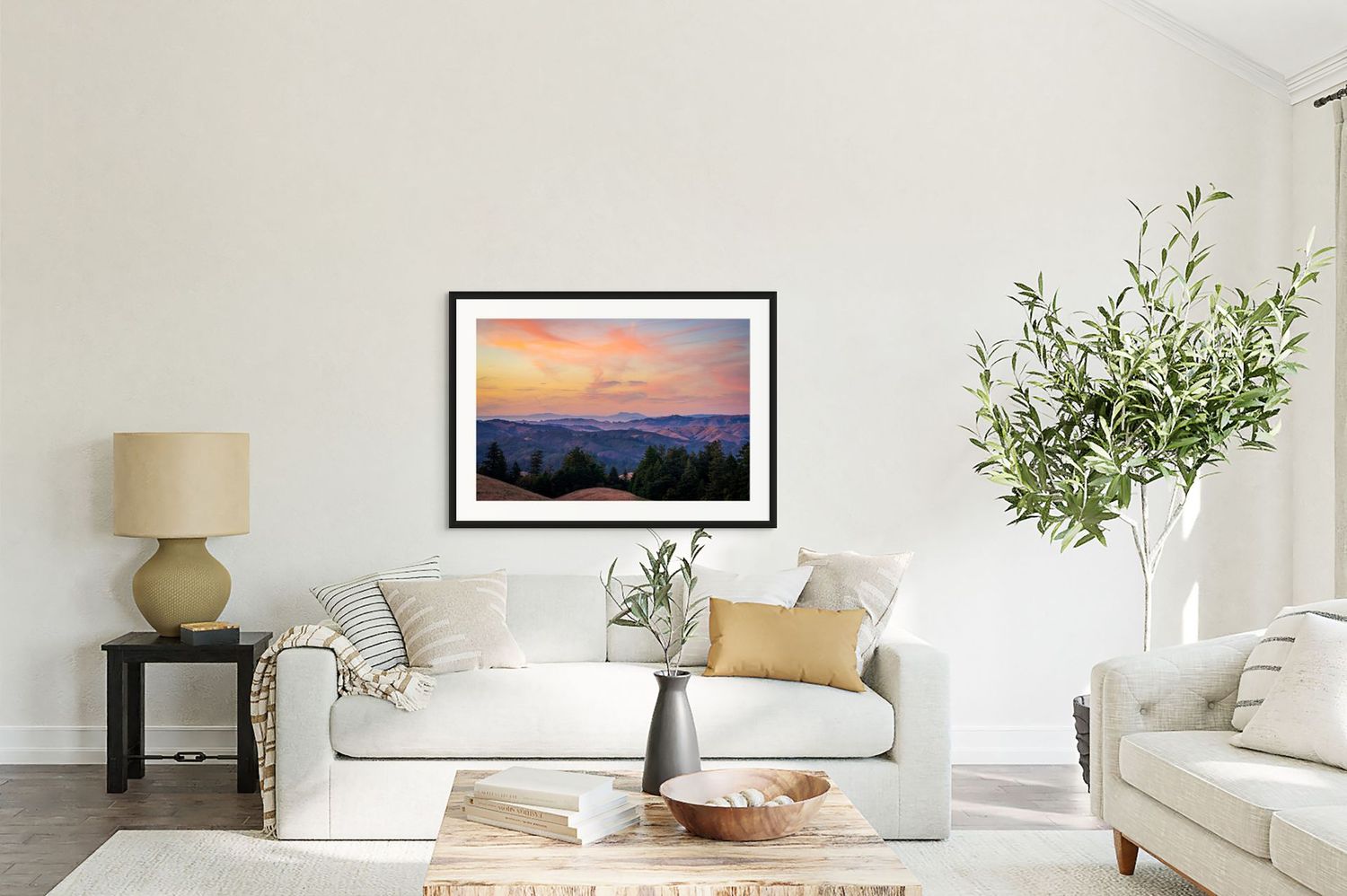
When someone asks me which print finish to choose, my first question back is always: what does the room feel like?
That might sound like I'm avoiding the question. I'm not. The truth is that each format — framed, metal, acrylic, and bamboo — does something genuinely different to a photograph. They're not interchangeable, and the right one depends less on the image itself than on where it's going to live.
Here's how I think about each one.
Framed Prints
A framed print is the most familiar and, for many spaces, the most natural choice. There's something about a frame that signals intention — it says this photograph was chosen, considered, and placed deliberately. Frames create a boundary between the image and the wall, which draws the eye inward and gives the photograph a sense of completeness.
I tend to recommend framed prints for living rooms, dining rooms, and bedrooms — spaces where people slow down and look. They work especially well in rooms with warm tones, natural materials, and traditional or transitional design. A simple black or natural wood frame on a white or linen wall is hard to beat.
The prints themselves are made on archival photo paper, which renders color and tonal gradations beautifully. My black and white work in particular takes on a depth in a framed print that I find deeply satisfying — the shadows breathe, and the highlights stay clean.
Metal Prints
Metal prints are the most modern of the formats, and they behave differently from anything else. The image is infused directly into an aluminum sheet, which gives the photograph a luminosity that seems to come from within rather than from reflected light. Highlights glow. Shadows have presence. The surface is sleek and borderless.
They work best in contemporary spaces — clean lines, minimal clutter, cool tones. A metal print on a light gray or white wall in a modern interior has a quiet authority. They're also incredibly durable, easy to clean, and don't require glass, which eliminates any glare issues entirely.
If you're drawn to my color work — coastal light, golden desert skies, the warmth of late afternoon — metal tends to amplify that luminosity in a way that other formats don't quite match.
Acrylic Prints
Acrylic prints are mounted behind a sheet of clear acrylic, which gives the image extraordinary depth and color saturation. More than any other format, acrylic makes a photograph feel like you're looking into it rather than at it. The effect is immersive.
These work well as statement pieces — a single large print in an entryway, a feature wall in a living room, or anywhere you want the photograph to anchor the space. They have a gallery-quality presence and tend to command attention. If you have a favorite image and you want it to stop people in their tracks, acrylic is worth serious consideration.
The depth of the material also means they're particularly suited to landscapes with a strong sense of space — wide vistas, open sky, the kind of image where you want to feel like you could step in.
Bamboo Prints
Bamboo prints are printed on a panel made from sustainable bamboo, which gives the image a warm, organic quality unlike any other surface. The natural tone of the bamboo subtly shifts the color palette toward the warm end of the spectrum. They feel handmade in a way that resonates in spaces with natural materials — wood floors, linen, stone, rattan.
These are a quieter choice, but a considered one. They suit images that have an earthy, textural quality — close-up studies of rock and bark, landscapes with warm golden light, anything where the organic quality of the substrate adds rather than distracts.
The Short Version
If you're still unsure, here's a simple starting point: framed for traditional and warm spaces, metal for modern and bright ones, acrylic for a statement piece, bamboo for natural and organic interiors. When in doubt, the framed print is almost always right.
And if you'd like to talk through a specific image or space, I'm always happy to help. Just get in touch.